Haller Treasure Chest
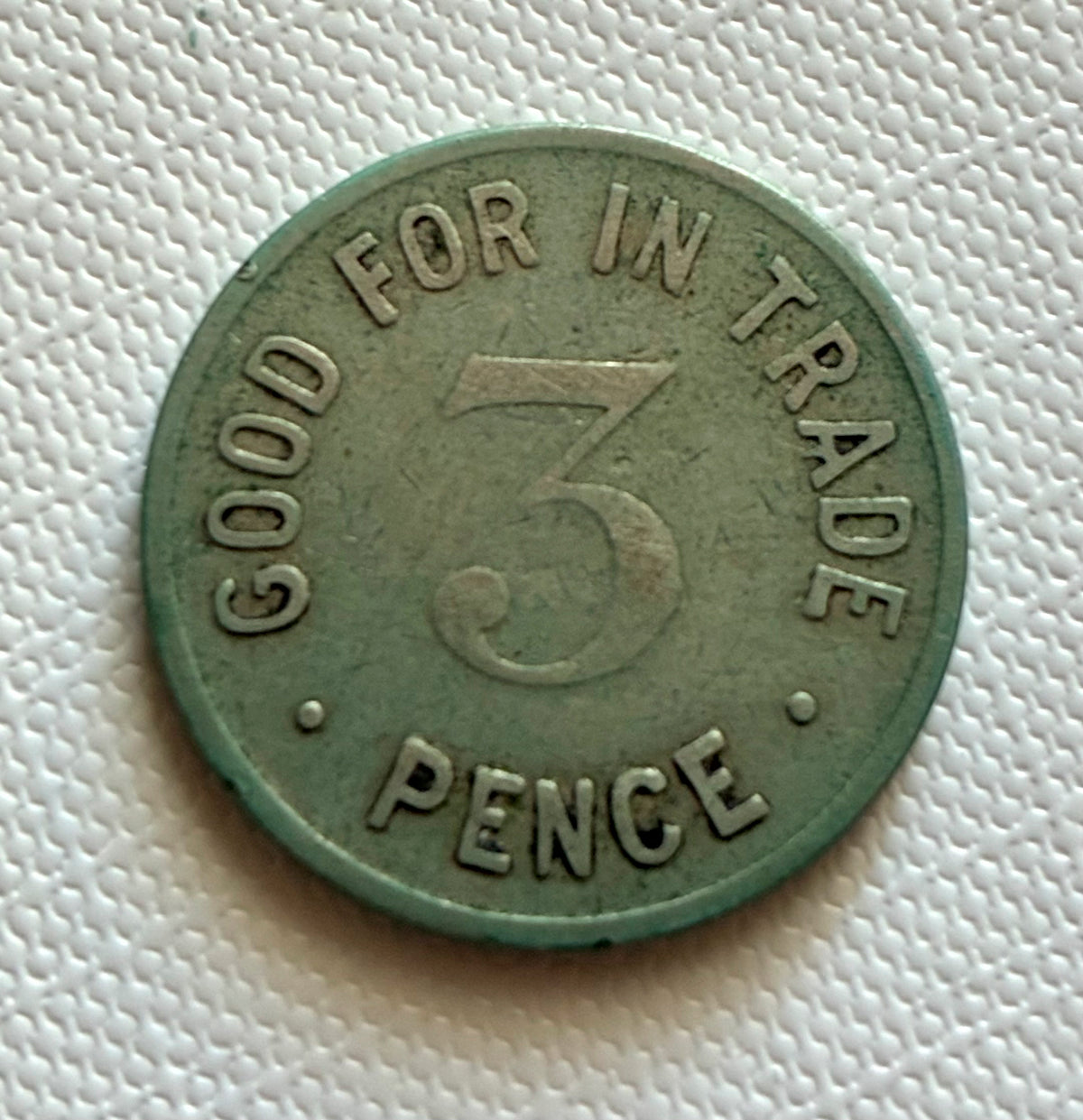
Token 31 – Southern Africa – “GOOD FOR IN TRADE – 3 PENCE” Trade Token, c. late 19th–early 20th century
Token 31 – Southern Africa – “GOOD FOR IN TRADE – 3 PENCE” Trade Token, c. late 19th–early 20th century
No se pudo cargar la disponibilidad de retiro
Token 31 – Southern Africa – “GOOD FOR IN TRADE – 3 PENCE” Trade Token, c. late 19th–early 20th century
An intriguing original 3 Pence private trade token bearing the unusual inscription “GOOD FOR IN TRADE – 3 PENCE”, with a single dot on each side and the same design repeated on both faces.
Unlike the German Werth-Marken, this piece belongs to the wider British and Southern African merchant-token tradition, where privately issued tokens were used in commercial transactions and circulated for goods or services rather than functioning as official coinage.
The use of the 3 Pence denomination is particularly interesting. British currency denominations were widely used throughout Southern Africa during the late 19th and early 20th centuries, including in commercial environments in the Cape and other parts of the region.
A particularly interesting collector connection is that an essentially matching 3 Pence “GOOD FOR IN TRADE” type has been documented in connection with Swakopmund. A matching example has been described as approximately 21 mm and 4 g in brass, with the same wording and layout. This makes a Swakopmund / German South West Africa association highly plausible, although the anonymous nature of the token means that the attribution should remain probable rather than certain.
The apparent silver-coloured surface should not automatically be interpreted as silver. The documented matching example is described as brass, and the greenish patina visible on this piece is compatible with a copper-alloy token.
For collectors of Southern African exonumia, Swakopmund history, German South West Africa and British colonial trade tokens, this is an especially fascinating piece. Its anonymous merchant origin, British 3 Pence denomination and possible Swakopmund connection make it an unusual survivor of the commercial token tradition of Southern Africa.
Share